A Telescope is a device which makes things visible to the naked eye which we would not normally be able to see.
The Earth’s atmosphere absorbs almost all electromagnetic radiation (except light, ultraviolet and radio waves). This limits the amount of information we can collect from space.
We need to use satellites to collect data on the wavelengths of the spectrum that are absorbed high in the atmosphere.
We can also use orbiting optical telescopes to get clearer views of deep space. These orbiting observatories have been used to discover gamma ray bursts, pulsars, black holes and extra solar planets. Read on to see how telescopes have developed over the years.
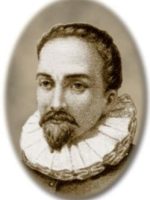
Hans Lippershey (1570-1619)
I’m German telescope inventor Hans Lippershey! In 1608 after some considerable messing about with optical lenses in my spectacle shop I submitted a patent application for the ‘Dutch Perspective Glass’. It could magnify objects by a factor of three. I never did receive that patent but was amply compensated with a ton of cash! Auf Wiedersehen!
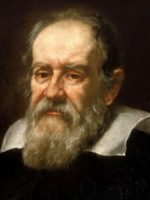
Galileo Galilei (1564-1642)
Buon Giorno! In 1609 I had heard about Hans Lippershey’s telescope design and decided to build my own. It was great! (a magnification of x33!). It was so great in fact that in 1610 I used it to discover three moons orbiting the planet Jupiter! This supported Nicolaus Copernicus’ idea that the Earth was not the centre of the universe. Unfortunately this got me into trouble with the Catholic Church (who eventually had me put under house arrest for Heresy!). Still, never mind! Ciao!
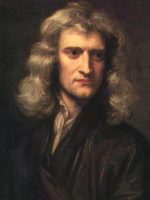
Sir Isaac Newton (1643-1727)
Somewhat typically, I, Sir Isaac Newton have improved upon the original refracting telescope design with my new reflecting telescope (built by me in 1670). This uses a big mirror instead of a lens and is much less likely to suffer distortion effects.
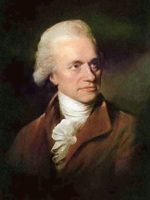
William Herschel (1738-1822)
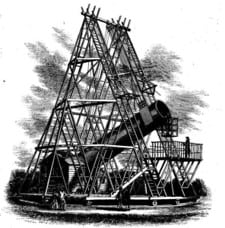
Hi! I’m William Herschel. In 1781 I discovered The Planet Uranus and in 1789 I used this massive 12m telescope to discover a new moon of the planet Saturn!
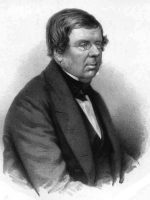
William Parsons (1800-1867)
Hi There! William Parsons, 3rd Earl of Rosse here. In 1845 I built the world’s biggest telescope (it had a 72” mirror!). I used this telescope to show the spiral nature of galaxies, in fact I discovered the Whirlpool Galaxy!
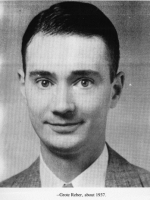
Grote Reber (1911-2002)
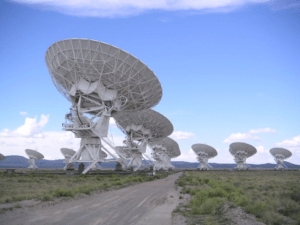
Gee Whiz! Hi there everyone! It’s me! Grote Reber, the father of Radio Astronomy! Following on from Karl Jansky’s 1933 discovery of radio waves emanating from the centre of the galaxy I built a radio telescope in my back garden in 1937! This enabled me to complete a radio frequency sky map in 1941! This in turn lead to an explosion in radio astronomy at the end of the Second World War.