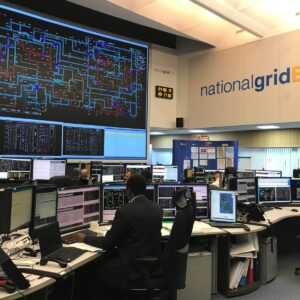
The National Grid network is made of high-voltage power lines, gas pipelines, interconnectors and storage facilities that together enables the distribution of electricity.
The grid ensures that all areas of Great Britain always have enough power.
How does it get to our homes?
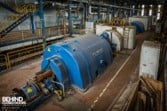
1.Electricity is made at a generating station by huge generators. Generating stations can use wind, coal, natural gas, or water.
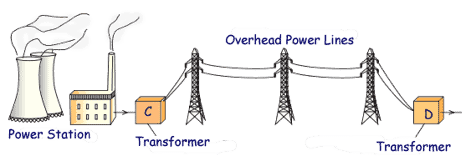
2.The current is sent through transformers to increase the voltage to push the power long distances.
3.The electrical charge goes through high-voltage transmission lines that stretch across the country.
4.It reaches a substation, where the voltage is lowered so it can be sent on smaller power lines.
5.It travels through distribution lines to your neighborhood. Smaller transformers reduce the voltage again to make the power safe to use in our homes. These smaller transformers may be mounted on the poles or sitting on the ground.
6.It connects to your house and passes through a meter that measures how much your family uses.
Transfomers
To move power around the National Grid: – before electrical power leaves a power station– it is transferred at high voltages by using ‘step-up’ transformers to increase the voltage to around 275,000 V
– before electrical power enters homes and factories– the voltages are decreased by ‘step-down’ transformers to 230 V
The transfer of electrical energy via the grid is very efficient. When currents in a cable are higher, more energy is dissipated to the surroundings through heating. As high currents waste more energy than low currents, electrical power is transported around the grid at a high voltage and a low current