logo21

More electromagnets

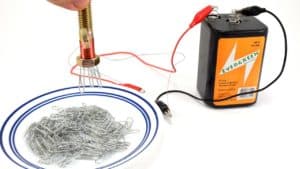
Last week we looked at making an electromagnet with a battery and a coil of wire. 
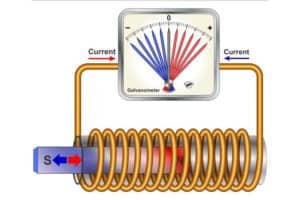
This lesson we are going to learn about using a magnet and a coil of wire to induce a current. 

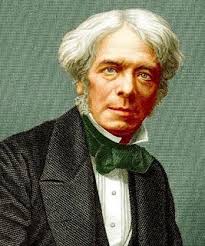
Michael Faraday was an English physicist working in the early 1800’s. He worked with another scientist named Sir Humphrey Davy. Faraday’s big discovery happened in 1831 when he found that when you change a magnetic field, you can create an electric current. He did a lot of other work with electricity such as making generators and experimenting with electrochemistry and electrolysis.

potential difference or voltage is needed to make an electric current flow in a circuit.

  • a coil of wire is moved in a magnetic field
  • a magnet is moved into a coil of wire

This is called electromagnetic induction 

The induced voltage produces an induced current if the conductor is connected in a complete circuit. 
As with all currents, the induced current creates a magnetic field around itself. 

For example, if a magnet is moved into a coil of wire, the induced magnetic field tends to repel the magnet back out of the coil. This effect occurs whether a magnet is moved into a coil, or a coil is moved around a magnet.
 

Factors affecting the induced potential

The direction of the induced potential difference or induced current depends on the direction of movement. The current is reversed when:

  • the magnet is moved out of the coil
  • the other pole of the magnet is moved into the coil

What to do next...

STILE (Online)

Printable

More Information?