Waves are vibrations that transfer energy from one place to another.
No matter (solid, liquid, gas) is transferred, just energy.
Transverse
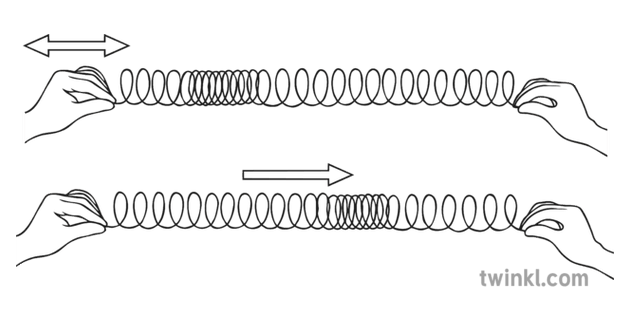
In transverse waves the particles all move at right angles to the direction of the wave
EXAMPLES:
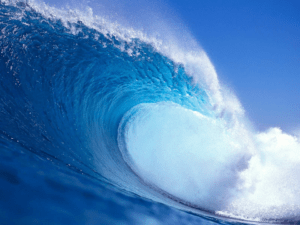
Light waves Other electromagnetic waves Some seismic waves Sea waves
Longitudinal
In longitudinal waves the particles all move in the same direction as the wave is travelling.
EXAMPLES: Sound waves Some seismic waves
Parts of a wave
You will have seen what a wave looks like in the unit about sound. You should remember that we talked about pitch and loudness when we talked about sound waves.
These actually relate to the amplitude and the wavelength.
High pitch sounds have a short wavelength and low pitch sounds have a long wavelength.
Loud sounds have a bigger amplitude (are taller) than quiet sounds.
Amplitude
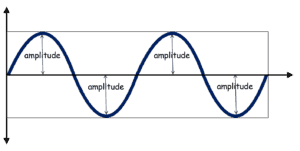
The amplitude is the maximum distance of a point on the wave from its rest position (measured in metres).
Frequency
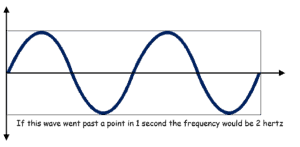
The frequency is the number of waves passing a point each second (measured in hertz).
Wavelength
The wave length is the distance from the point of one wave to the same point on the next wave (measured in metres).