The world’s continents are slowly moving. Over millions of years they can travel huge distances, changing the face of the Earth.
In the 1960s, scientists developed a new theory to explain why the continents move. They proposed that the Earth’s surface is broken up into rigid slabs of rock called tectonic plates.
These plates make up the top layer of the Earth called the lithosphere. Directly under that layer is the asthenosphere. It’s a flowing area of molten rock. There is constant heat and radiation given off from the center of the Earth. That energy is what constantly heats the rocks and melts them. The tectonic plates are floating on top of the molten rock and moving around the planet. Think of it as ice floating at the top of your soda. When the continents and plates move it’s called continental drift.
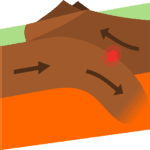
Destructive boundaries (also known as convergent boundaries)
A boundary where the plates are moving towards each other. Often, the denser of the two plates is pushed under the other plate where it moves into the mantle and melts. This creates molten rock (magma) which can then be pushed up through the plates, causing earthquakes and volcanoes. The molten rock then cools to form new igneous rock.
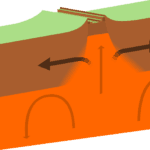
Constructive boundaries (also known as divergent boundaries)
A boundary where the plates are moving away from each other. Magma from beneath the plates is released from the gap and rises up, cools and forms new igneous rock. If this happens under pressure, it is known as a volcanic eruption. An example of this boundary type is the Mid-Atlantic ridge.
Conservative boundaries
A boundary where the plates slide past one another without moving towards or away from each other. If the plates move a significant distance very suddenly, this causes an earthquake. There are no volcanoes at this type of boundary as melting of the rock does not occur. An example of this type of boundary is the San Andreas fault, California.