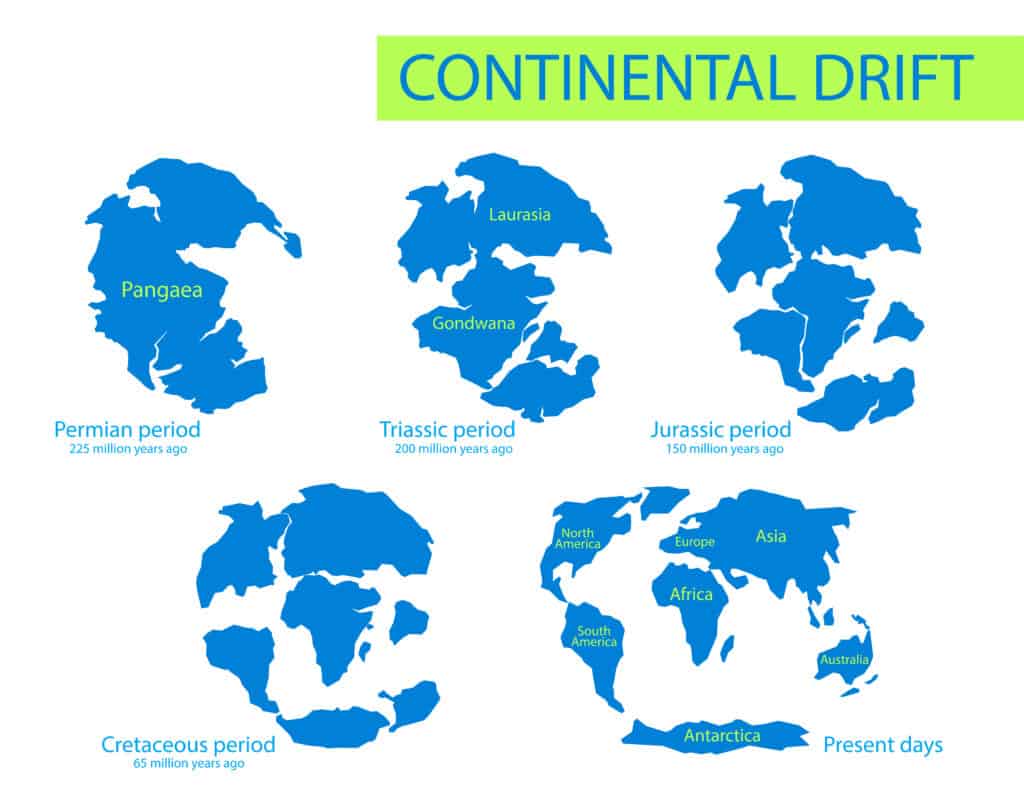
300 million years ago, Earth only had one supercontinent called Pangea.
Today it’s easy to identify the seven continents on a map.
It was noted as far back as 1596 that the Earth looked like puzzle pieces but it wasn’t until 1910 that Alfred Wegner formalized the theory of continental displacement or continental drift, and named the landmass Pangea.
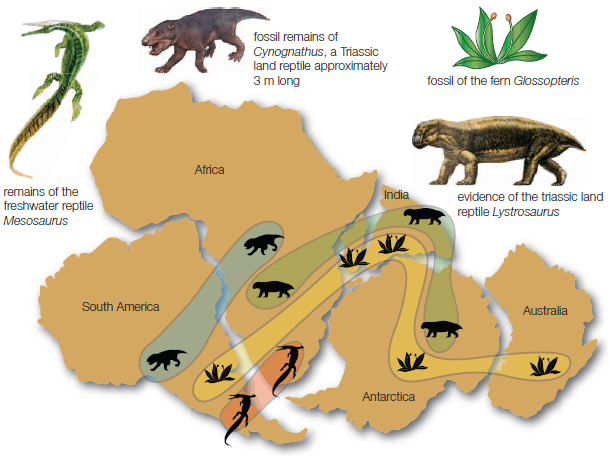
In 1911 Wegener set out to prove his theory of Pangea by comparing fossil records along the continental boundaries. His investigation established fossils from multiple species that existed along the coastlines where South America and Western Africa had been joined. The fossil record also shows extinct plants, such as the seed fern Glossopteris, grew on what are now widely divided continents.
During and after World War 2, scientists used new technology to make some exciting discoveries about the ocean floor.
They found long mountain ranges where underwater volcanic eruptions are creating new igneous rock. The new crust formed by these eruptions is causing the seafloor to slowly spread apart. This process is called seafloor spreading.
This discovery provided surprising new evidence in support of Wegener’s theory. If large sections of the crust were moving horizontally, they could carry along continents with them!
The new evidence soon convinced the scientific community that Wegener’s theory of continental drift was basically right.