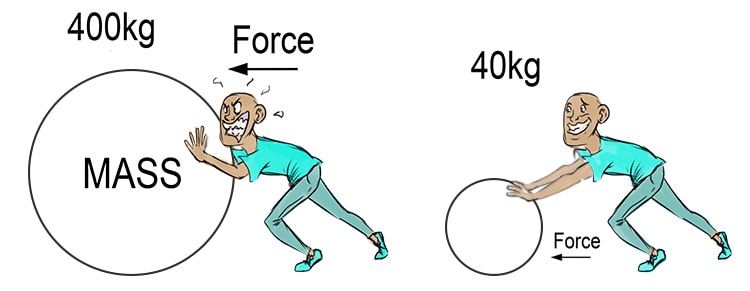
The acceleration of an object is a measure of how much its velocity changes in a certain time. Newton’s second law of motion describes the things that affect the acceleration of an object.
The acceleration in the direction of the resultant force depends on:
the size of the force
the mass of the object
This means that for an object that has the same mass, the bigger the force the bigger the acceleration
for an object that is being pushed with the same force, the bigger the mass the smaller the acceleration.
Calculations
The force needed to accelerate a particular object can be worked out using the equation.
Force = mass x acceleration.
The equation triangle on the right shows the relationship between force, mass and acceleration. It can tell us that:
Mass = force ÷ acceleration Acceleration = force ÷ mass
Example
A motorcycle has a mass of 200 kg. What force is needed to give it an acceleration of 7 m/s2 ?
F = m x a = 200 x 7 = 1400N
Core Practical
In school we would do a practical like the one in the videos on the right.
Make sure you watch one of these videos so that you can answer the questions if we are not able to do it via TEAMS