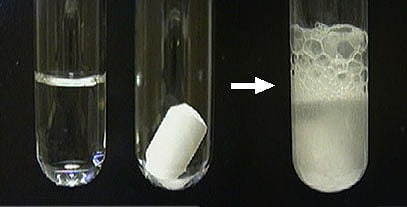
In physical changes, no new substances are made. New substances are made during chemical reactions (chemical changes)
In a chemical reaction you may see a change in colour, a gas being formed or energy being released. It is hard to reverse chemical changes.
The chemical properties of a substance describes how it reacts with other substances. Flammability and reaction with acids are examples.
Scientific Method
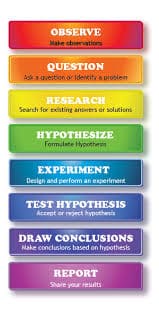
Unlike Democritus, John Dalton used a scientific method to develop his atomic theory. He developed a hypothesis or idea, which he tested by making predictions. Predictions are best guesses. He formed his theory only using the hypotheses that were supported by evidence.
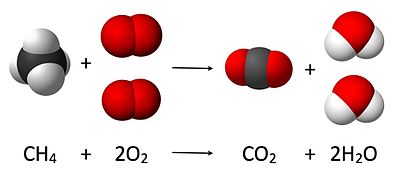
One prediction made from Dalton’s ideas was that the mass of what is made (the products) is the same as the mass of the reactants (the ingredients)
He explained this by saying that atoms can not be created or destroyed they just rearrange.
Ratios and Mass
Dalton also noticed that the masses of elements always reacted in the same proportion or ratio.
For example when the two chemicals above react the number of atoms doesn’t change. What ever mass of methane you need twice as much oxygen.
Chemical Formula
The ratio of elements in a compound is shown in a chemical formula. The ratio is shown using small numbers after the symbols. For example the formula for water shows there are two hydrogens for every one oxygen. The ratio is 2:1
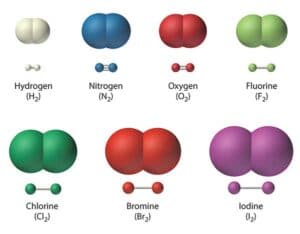
Some compounds exist as individual molecules. Some elements also exist as molecules, so these have chemical formulae. There are some common ones in the picture on the right.